Oracle Cards vs Tarot: A Complete Guide for Witches
Share
Oracle Cards vs Tarot: A Complete Guide for Witches
Learn what makes oracle cards different from tarot, their history from Lenormand to today, and how to use oracle and tarot together in your practice.
Both tarot and oracle cards are tools for divination and self-reflection, but they work differently, feel different in practice, and suit different purposes. Neither is more powerful or more legitimate than the other. The better question is: which is more useful for what you actually want to do?
The Structural Difference
This is the most important distinction to understand, and it makes everything else clearer. Tarot is a fixed system. Oracle is a free-form system. That single difference shapes how each is read, how each is learned, and what each can do well.
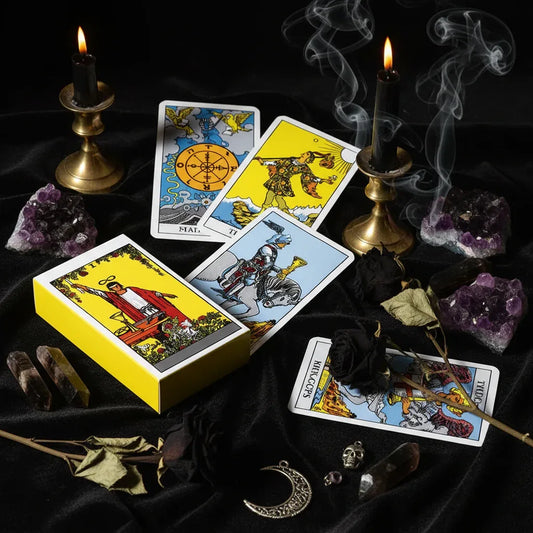
A standard tarot deck contains exactly 78 cards, divided into two sections. The Major Arcana consists of 22 cards representing archetypal forces and major life themes: the Fool, the High Priestess, the Tower, the World, and their nineteen companions. The Minor Arcana consists of 56 cards organised into four suits (Wands, Cups, Swords, and Pentacles in the Rider-Waite tradition), each suit running from Ace through Ten plus four court cards. This structure is the same across virtually all tarot decks, regardless of their artwork or theme. A Thoth deck and a Rider-Waite-Smith deck and a Marseille deck are all recognisably tarot and share the underlying architecture.
Because of this fixed structure, the meanings of individual cards are shared across the tarot tradition. The Ten of Swords has recognisable meanings that a reader can bring from one deck to another. Learning tarot is substantially a process of learning the meanings associated with each of 78 positions, and then developing the skill of reading those meanings in context and in relation to one another.
An oracle deck, by contrast, has no fixed structure at all. The creator of an oracle deck decides how many cards it will have, what imagery it will use, what meanings will be assigned to each card, and what system (if any) will govern the relationships between cards. An oracle deck can have 25 cards or 55 cards or 81 cards. It might be organised around animals, goddesses, plants, crystals, archetypes, emotions, seasons, or any other theme the creator finds meaningful. The creator defines all meanings, and those meanings do not transfer to other oracle decks.
A useful analogy: tarot is like a chess set. The pieces are fixed (king, queen, bishop, knight, rook, pawn), their relationships and movement rules are established and consistent, and while chess sets come in hundreds of aesthetic designs, they all use the same underlying game. Oracle is like a custom card game: the creator sets the number of cards, the rules, the values, and the theme. Two oracle decks from different creators are as different from each other as Snakes and Ladders is from Scrabble.
A Brief History of Oracle Cards
Tarot itself predates what we now call oracle cards. Tarot decks emerged in fifteenth-century northern Italy, initially as playing cards for games such as tarocchi, before being adopted for divination purposes from the late eighteenth century onward. The first purpose-built divinatory card system distinct from tarot was the Lenormand system.
Marie Anne Lenormand (1772 to 1843) was a French cartomancer of considerable contemporary fame, who reportedly read for Napoleon Bonaparte and Empress Josephine. The deck that bears her name was published posthumously and standardised around 36 cards, each with a simple symbolic image (the ship, the house, the clover, the coffin, the letter, and so on) and a specific, relatively stable divinatory meaning. Lenormand reading is its own system, distinct from tarot in method as well as structure, and remains widely practised particularly in German-speaking countries and parts of Eastern Europe.
Kipper cards, another German system from the late nineteenth century, function similarly: a fixed set of cards with established meanings used in combination, more focused on everyday life situations and relationships than on psychological depth or archetypal symbolism.
The shift toward what we now call the modern oracle deck began in the twentieth century. Angel card decks, drawing on New Age spirituality and developed by authors such as Doreen Virtue from the 1990s onward, were enormously commercially successful and established a template of illustrated cards with affirming messages. The explosion of themed oracle decks since roughly 2000, covering crystals, nature spirits, feminine archetypes, shadow work, plant medicine, moon phases, and virtually every other theme imaginable, represents a creative democratisation of the divination card format. Small independent creators now publish oracle decks through crowdfunding and print-on-demand, making the market extraordinarily diverse.
How to Choose Between Oracle and Tarot
Choose Tarot If
- You want to study a structured, established system
- You enjoy the depth of having 78 cards with distinct meanings
- You want your card knowledge to be portable across many decks
- You are drawn to archetypes and the Major/Minor Arcana framework
- You want to use named spreads designed around card positions
- You enjoy the intellectual dimension of learning a complex system
Choose Oracle If
- You want immediate, intuitive reading without prior study
- A particular deck's theme resonates strongly with your practice
- You prefer flexibility over fixed card meanings
- You want a daily guidance practice that feels less demanding
- You are drawn to imagery and your own interpretive response
- You want something that serves as a creative or meditative prompt
Many practitioners use both, and the two systems complement each other well. A common pattern is to use an oracle deck for daily guidance and regular check-ins, and a tarot deck for deeper readings when a question requires more structure or when multiple aspects of a situation need to be explored. The tarot's architectural complexity is a strength for complex questions; the oracle's directness is a strength for simple, present-moment engagement.
Reading Oracle Cards Without a Guidebook
Most oracle decks come with a guidebook that provides the creator's intended meaning for each card. The guidebook is useful, particularly when you are first learning a new deck's language. However, one of the particular strengths of oracle cards is that they can be read intuitively without reference to any external authority, which is not always true of tarot, where the established meanings of cards form part of the tradition.
When approaching an oracle card without the guidebook:
- Look at the image without naming it. What feeling does it give you before your analytical mind categorises it? That first, pre-verbal response is often the most accurate one.
- Ask what the image suggests about your question. Not what it means in general, but what it has to say specifically to the question you brought to the reading. Context makes meaning.
- Notice what draws your eye. If a detail in a corner of the image pulls your attention, that detail is worth examining. The eyes do not wander randomly when engaged with meaningful imagery.
- Use your journal. Write down your immediate, unfiltered response to the card. Then read the guidebook meaning, if you choose to, and note where the two overlap or diverge. Over time, this builds a personal relationship with the deck that goes beyond the creator's original intentions.
Oracle Cards in Spellwork and Ritual
Oracle cards are not limited to divination. They have a natural place in ritual and spellwork as focal points and intention-holders.
Drawing a card to set the intention of a working. Before beginning a spell or ritual, draw one oracle card and let it name the energy of the working. A card drawn as "the quality this working carries" can focus intention more vividly than a written affirmation alone. Place it on your altar for the duration of the working.
Using cards as altar focal points. An oracle card placed at the centre of an altar, face up, makes visible the intention of the altar as a whole. For a love spell altar, a card showing connection or opening; for a protection working, a card showing strength or boundary; for a grief ritual, a card showing the presence of what has been lost. The card works as both symbol and anchor.
Charging cards on a full moon. Oracle cards, like crystals and other ritual tools, can be set out under the full moon to cleanse and charge them. Lay the deck face up on a windowsill or outside under the full moon for the night, or leave a single card that has been particularly meaningful in recent workings. Some practitioners hold favourite cards during candle meditations or keep a significant card tucked into a Book of Shadows for an ongoing working.
Five Daily Oracle Card Methods
-
Morning Guidance PullDraw one card before you engage with the day. Ask: what quality or awareness would serve me today? Place the card somewhere visible and let it work on you as the day unfolds. Return to it in the evening and note what you noticed.
-
Evening Reflection PullDraw one card at the end of the day and ask: what was the gift or the lesson in today? This works particularly well on difficult days, when the oracle often surfaces something that was easy to miss in the noise of what went wrong.
-
Week-Ahead Seven-Card SpreadDraw seven cards on Sunday evening, one for each day of the coming week. Lay them in a line and note what sequence or progression emerges. You are not predicting events, but setting a tone for each day. Review each morning whether the card's energy was visible in the day.
-
Monthly Theme CardAt the new moon, draw one oracle card as the guiding theme for the lunation cycle. Keep this card on your altar for the full month. Return to it at the full moon and at the end of the month to see how its message evolved and what it was actually pointing to.
-
Question-and-Answer DialogueState a question, draw a card as the response. Then ask a follow-up question prompted by the card, draw again. Continue for three to five rounds. This creates a dialogue with the deck that can go surprisingly deep on complex questions. Journal the whole exchange.
Pairing Oracle and Tarot in the Same Reading
Using oracle and tarot together in a single reading is a technique many experienced practitioners find valuable. The two card systems bring different qualities: tarot tends toward specificity, structure, and the examination of causes and consequences; oracle tends toward energy, message, and the broader spiritual or emotional quality of a situation.
A simple way to combine them: perform a three-card tarot spread for the what, the why, and the how of your question, then draw one oracle card at the end as a "spirit message" or "overarching energy." The tarot gives you the mechanics; the oracle gives you the atmosphere. Many readers find that the oracle card illuminates something the tarot spread was circling but not quite landing on directly.
An example structure: you are navigating a decision about work. Your three tarot cards might show: current situation (Five of Pentacles: scarcity mindset, feeling unsupported), what underlies it (Four of Cups: emotional withdrawal, opportunity being missed), what action to consider (The Star: hope, trusting in alignment). Your oracle card, drawn as the spiritual energy of the situation, might show an image of a river: movement, surrender to current, trust in direction. The oracle does not contradict the tarot; it adds a felt sense that the tarot's precise language was gesturing toward.
First Week with a New Oracle Deck
A simple protocol for building a genuine relationship with a new deck, rather than just flipping through it once and putting it on a shelf.
- Day 1: Go through all the cards face up without shuffling. Look at each one for ten to fifteen seconds. Note which three pull your attention most strongly and which one you feel resistance to. Write these down.
- Day 2 to 3: Cleanse the deck. Options: leave it under moonlight overnight, wrap it with a piece of selenite, pass smoke over it, or simply hold it in both hands and set a quiet intention of openness.
- Day 4: Draw one card and journal about it for ten minutes without looking at the guidebook. Then read the guidebook entry and note what surprised you.
- Days 5 to 7: Carry one card with you each day. Set it somewhere you will see it regularly, your desk, beside your bed, tucked in your bag. Let it be present in your daily life rather than only in dedicated reading sessions.
- End of week: Look at the three cards you noted on Day 1 that pulled you most. Are they still the same? Have you drawn any of them in your daily pulls? These cards are likely significant in your relationship with this deck.
Find Your Deck
Whether you are drawn to the structure of tarot or the intuitive freedom of oracle, browse the full range of decks.
Frequently Asked Questions
Can beginners use oracle cards?
Yes, and many practitioners start with oracle cards before tarot precisely because they require no prior study of an established system. You choose a deck whose imagery speaks to you, you shuffle with a question in mind, you draw a card, and you respond to what you see. The guidebook is there if you need it, but it is not required.
Oracle cards are also a good choice for beginners who want the meditative and self-reflective benefits of card reading without the commitment of learning 78 distinct tarot cards. A daily oracle pull is an accessible entry point that can serve a practice indefinitely or form a bridge into tarot study.
Do oracle cards have the same meanings as tarot cards?
No. Oracle cards and tarot cards are entirely separate systems. Even when an oracle deck appears to draw on similar imagery or archetypes to tarot, the meanings are defined by the oracle deck's creator rather than by any shared tradition. The Ten of Swords in a tarot deck has a specific traditional meaning (painful ending, hitting rock bottom, dramatic conclusion). An oracle card called "The Sword" in a different deck might mean clarity, truth-cutting, or decision, depending on what that deck's creator assigned to it.
This is why knowledge of tarot does not automatically transfer to oracle reading and vice versa. Each oracle deck requires its own engagement, either through the guidebook, through intuitive response to the imagery, or through building a personal relationship with the deck over time.
Is one more accurate than the other?
The concept of accuracy in divination is worth examining. Neither tarot nor oracle is literally predicting fixed future events. Both are tools for reflection, insight, and accessing intuition. Whether one feels more "accurate" to a reader is largely a function of how well that reader has built a relationship with the specific deck and system, and how well the question was framed.
Many practitioners report that tarot readings feel more precise for complex, multi-layered questions because the structured architecture allows for more differentiated responses. Oracle readings often feel more resonant for questions about energy, emotional undercurrents, or spiritual guidance. Both are most useful when the reader is genuinely present and the question is genuine. Neither is a parlour trick, and neither is infallible.
How many decks do I need?
One is enough to begin. One deck, well-used and genuinely understood, is more valuable than a collection of twenty decks that are each pulled out occasionally. The relationship between a reader and a specific deck deepens over time, and that depth is what makes readings genuinely useful rather than surface-level.
Many long-term practitioners do build collections, and there is nothing wrong with having multiple decks for different purposes: one for everyday pulls, one for deep or formal readings, one for specific workings or seasonal use. But the impulse to buy many decks at once, particularly when starting out, often comes more from the aesthetic pleasure of card collecting than from actual practice needs. Buy the second deck when the first one has become a genuine working relationship.
Printable tarot workbook
Give every card its own page
Learn the deck by candlelight. Each card gets a page of meanings, keywords and room for your own reading, and every spread you try has somewhere to live. Works with any standard deck. Instant A4 PDF.