Potion Ingredients and Supplies: What Every Witch Needs to Brew
Share
Potion Ingredients and Supplies: What Every Witch Needs to Brew
Stock your potion pantry with the right herbs, essential oils, carrier bases, and tools. A practical guide to building your potion-making kit from scratch.
Potion-making is one of the oldest forms of magical practice, and one of the most accessible. Everything you need to begin is either already in your kitchen or available from a health food shop. This guide walks you through the full picture, from your herb pantry through to your tools and safety practice.
What a Potion Actually Is in Witchcraft
The word "potion" carries a lot of fantasy-fiction baggage: bubbling cauldrons, iridescent liquids, mysterious transformations. In witchcraft practice, a potion is more practical and more interesting than the archetype suggests. A potion is a prepared magical liquid or blend, created with intention, that carries a specific magical purpose. It is the application of correspondences, the knowledge that certain plants, oils, and preparations carry energetic qualities, combined with the witch's own intent and focus.
A potion is not simply a herbal tea, though a herbal tea can be a potion if it is prepared and consumed with magical intention. The difference lies in the intent and the awareness brought to the preparation. When you brew chamomile tea because you want to sleep, you are making a beverage. When you brew chamomile tea at the dark of the moon, with a spoken intention for peace and clarity, infused with a clear intention and perhaps charged over a blue candle before drinking, you are making a potion.
Potions do not have to be drunk. Many are applied to the skin as anointing oils, used to dress candles or altar cloths, sprinkled around a space, poured into ritual baths, or placed in spell bottles. The mode of use depends on the intention of the working. A potion for protection might be sprinkled at doorways; one for self-love might go into a bath; one for clarity might anoint a candle.
Your Core Herb Pantry
The following fifteen herbs form the backbone of a functional potion pantry. They cover the most common magical intentions, are widely available in Australia from health food stores and online suppliers, and are relatively safe in external applications. Internal use of any herb should be researched fully before attempting.
| Herb | Primary Magical Use | Notes and Cautions |
|---|---|---|
| Lavender | Calm, sleep, purification, peace | One of the safest and most versatile herbs; suitable for bath infusions, sleep sachets, and anointing oils when diluted |
| Rosemary | Protection, memory, cleansing, mental clarity | A powerful all-purpose herb; can substitute for many other protective plants; avoid in high concentrations during pregnancy |
| Mugwort | Dreams, divination, psychic vision, astral travel | Commonly used in dream pillows and pre-sleep teas; do not use internally if pregnant; stimulates vivid dreaming |
| Chamomile | Peace, luck, prosperity, calming energy | Gentle and widely used; suitable for internal teas when prepared as such with intention; note potential allergy in those sensitive to the daisy family |
| Valerian Root | Sleep, deep trance, protection, grounding | Strong-smelling; effective for sleep workings; consult a health professional before internal use, particularly if on medication |
| Peppermint | Energy, travel, clarity, purification | Refreshing and activating; good in clarity potions and purification sprays; avoid in high concentration on skin without dilution |
| Rose Petals | Love, self-love, beauty magic, emotional opening | Dried rose petals from culinary-grade sources are suitable; use fresh petals from untreated gardens for highest potency |
| Calendula | Sun magic, healing, protection, abundance | Bright and solar in energy; excellent in healing oil blends and bath preparations; generally very safe topically |
| Yarrow | Courage, psychic ability, protection, boundary-setting | Traditional wound herb in folk practice; used in courage and warrior workings; avoid during pregnancy; may cause skin sensitivity in some |
| Thyme | Purification, courage, love, seeing faery | Common kitchen herb with strong purification correspondence; excellent in cleansing sprays and floor washes |
| Nettle | Protection, strength, breaking hexes, warding | A fiercely protective herb; handle fresh nettle with gloves; dried nettle is safe and widely available |
| Lemon Balm | Calm, success, emotional healing, clarity | Gentle and effective; grows readily in Australian gardens; suitable for internal teas and bath infusions |
| Black Salt | Protection, banishing, warding, hex-breaking | Made from salt mixed with activated charcoal or ash; not a herb but a prepared ingredient; used in protection sprays and boundary workings |
| Cloves | Protection, prosperity, memory, banishing negativity | Warming and potent; use sparingly in oil blends as clove can irritate skin; safe in infusions used for space-clearing |
| Cinnamon | Speed, success, fire element activation, abundance | Activating and warming; accelerates other ingredients in a blend; dilute carefully in skin-applied oils as cinnamon can cause irritation |
Essential Oils for Potion Work
Essential oils allow you to work with plant energies in concentrated form. They should always be diluted in a carrier oil before skin application, typically at 1 to 3 percent concentration. Six oils that cover the majority of potion and anointing work:
Carrier Bases: What to Use and When
The carrier base is what holds your herbs and oils together and determines how the potion is applied. Choosing the right base for your working is one of the more practical skills in potion-making.
Water-Based Carriers
Water is the most versatile base. Moon water (water charged under a full moon) carries an added layer of lunar energy. Spring water from a known clean source is suitable for internal potions. Distilled water is appropriate for sprays and spritzes intended for space-clearing, as it extends shelf life. Water-based potions have the shortest shelf life; most should be used within a few days unless preserved with alcohol.
Oil-Based Carriers
Oil bases are used for anointing oils, candle-dressing potions, and skin-applied workings. Common choices include sweet almond oil (light, absorbs well, neutral scent), jojoba (technically a wax, extremely stable, long shelf life), and fractionated coconut oil (light, non-greasy, widely available). Oil bases do not dilute in water and are not suitable for potions intended to be drunk.
Alcohol and Vinegar Bases
Vodka or food-grade grain alcohol works excellently as a tincture base: it extracts plant compounds efficiently and preserves them. Tinctures made with vodka can last a year or more when stored correctly. Apple cider vinegar is a more accessible and slightly less potent alternative, used in floor washes, space-clearing sprays, and some traditional folk recipes. Both extend the shelf life of herbal preparations significantly.
Potion-Making Tools
You do not need specialist equipment. Much of what you require is already in a well-equipped kitchen. Dedicate the items you use for magical work so they carry accumulated intent over time.
- Glass jars: wide-mouth mason jars in various sizes for infusing, storing, and presenting finished potions. Glass is preferred over plastic as it does not leach into the preparation and can be easily cleansed and re-used.
- A mortar and pestle: for grinding dried herbs before adding them to an infusion or oil. The physical action of grinding is itself a focusing practice; put your intention into the grinding motion.
- Cheesecloth or fine mesh strainer: for straining plant material from finished liquid preparations. Cheesecloth can be cut to size and folded to produce a very fine filter.
- Labels: every finished potion should be labelled with its name, ingredients, date made, and intended use. This is both a safety practice and a way of building a record of your formulas.
- Dropper bottles: small dark glass bottles (amber or cobalt) with dropper lids are ideal for storing concentrated oil blends and tinctures. Dark glass protects the contents from light degradation.
- A dedicated pot or double boiler: for gently heating oil infusions. Low, slow heat preserves the plant's properties. A dedicated pot used only for magical work is ideal, but a clean pot used with intention works as well.
Starter Pantry Checklist
The minimum to begin meaningful potion work. Add to this as your practice develops.
- 5 core herbs: lavender, rosemary, chamomile, rose petals, peppermint
- 2 core oils: frankincense essential oil, lavender essential oil
- 1 carrier base: jojoba oil or fractionated coconut oil
- Glass jars: at least 4 to 6 clean wide-mouth jars in varying sizes
- A fine strainer or cheesecloth
- Labels and a dedicated pen
- A notebook for recording formulas
With these seven items, you can make cleansing sprays, anointing oils, sleep sachets, bath infusions, and protection preparations. That is more than enough to begin.
A practical safety note: Some herbs are contraindicated during pregnancy, including mugwort, clary sage, yarrow, rosemary in high concentration, and valerian. Some essential oils cause skin sensitisation or photosensitivity. Cinnamon and clove essential oils in particular should never be applied undiluted. Always label finished preparations clearly, store them away from children and pets, and research any herb before consuming it internally. When in doubt, use externally only.
Stock Your Potion Pantry
Browse herbs, tools, and witchcraft supplies to build your brewing kit.
Frequently Asked Questions
What is the difference between a potion and a herbal tea?
The difference is primarily one of intention and awareness. A herbal tea becomes a potion when it is prepared with conscious magical intent: a specific purpose spoken over the brewing, the herbs chosen for their magical correspondences rather than simply their flavour, and the resulting liquid used as part of a deliberate working.
Not all potions are suitable for drinking. Many are anointing oils, room sprays, floor washes, or bath infusions. A drinkable potion should be made only from herbs that are safe for internal consumption, which means researching each ingredient before brewing anything intended to be ingested.
Do potions have to be drunk to work?
No. The majority of potions in magical practice are applied externally or used in the environment rather than consumed. Anointing oils are rubbed onto candles, skin, or objects. Room sprays are misted through spaces. Bath potions are poured into water. Floor washes are used to cleanse thresholds and entryways. Potions can be sealed into spell bottles or buried at the perimeter of a property for protection.
Ingesting a potion is only one mode of application, and for many intentions it is not the most appropriate one. Choose the application method based on what you are trying to achieve.
How do I store herbal potions?
Storage depends on the base. Water-based potions without alcohol should be refrigerated and used within three to seven days. Oil-based preparations keep for several months in a cool, dark place; jojoba-based blends keep the longest, often a year or more. Alcohol tinctures stored in dark glass in a cool location can last a year or two.
Always store in dark glass when possible: amber or cobalt bottles protect from UV light degradation. Label every preparation with the date made, ingredients, and expiry expectation. A preparation that smells rancid or off has turned and should be discarded. When in doubt, dispose of it respectfully and make fresh.
Where can I buy herbs for witchcraft in Australia?
Dried herbs suitable for magical work are available from several Australian sources. Health food shops and bulk herb retailers such as Mountain Herbs, Australian Botanical Products, and various online suppliers stock culinary and medicinal-grade dried herbs that are entirely appropriate for potion work. Farmers' markets in most capital cities include herb stalls where you can buy fresh and dried herbs directly from growers.
Specialist witchcraft and pagan supply stores (online and physical) carry herbs selected specifically for magical use, often alongside information about their correspondences. For Australian-native alternatives, look for suppliers specifically stocking lemon myrtle, wattleseed, Australian sandalwood, and native botanicals. You can also grow your own: lavender, rosemary, lemon balm, chamomile, and thyme all grow well in most Australian climates.
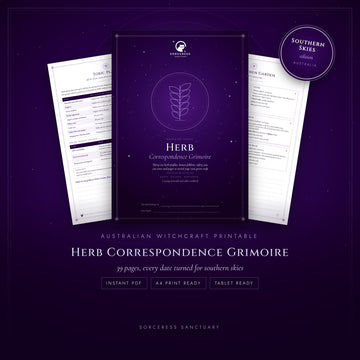
Printable herb grimoire
Keep every herb close at hand
Thirty-six herb profiles with honest folklore, correspondences and safety notes, ready for your potion shelf. Instant A4 PDF.