Jump to a Section
A Real History of Tarot
Did tarot actually start as a divination tool?
No. Tarot began as a card game called tarocchi in 15th-century Italy, played for entertainment among the nobility, and it did not become associated with divination and mysticism until the late 18th century, when French occultist Antoine Court de Gébelin proposed, without genuine historical evidence, that the cards held hidden ancient Egyptian wisdom.
There are 78 cards in a traditional tarot deck, 22 Major Arcana and 56 Minor Arcana, and each card tells part of a larger story, but that story originally had nothing to do with fortune-telling. The earliest surviving decks, hand-painted and lavish, were commissioned by wealthy Italian families like the Visconti and Sforza purely for a trick-taking card game similar to modern bridge.
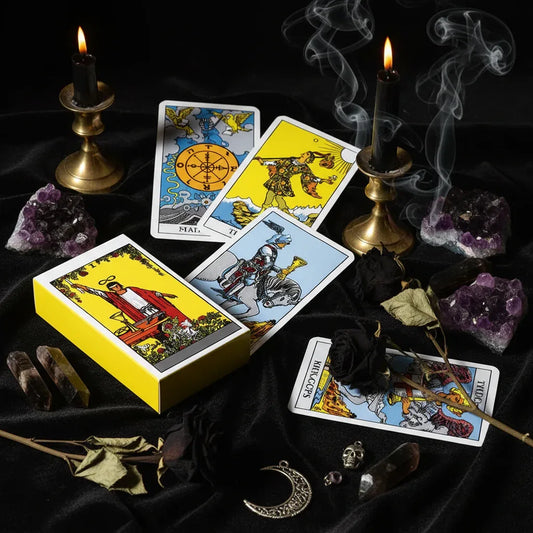
The transformation into an occult tool genuinely accelerated through the 19th century, particularly through the Hermetic Order of the Golden Dawn, a society devoted to esoteric study including Kabbalah and astrology. Two of its members, Arthur Edward Waite and artist Pamela Colman Smith, created the deck that would define modern tarot: published in 1909, the Rider-Waite-Smith deck was the first to give every single card, including the previously plain numbered Minor Arcana, a fully illustrated narrative scene. This single design choice is why most beginner-friendly decks today still follow its visual template, and why it remains the most widely used deck in the world.
Today, tarot is a core part of modern witchcraft, used for self-reflection, guidance, and even spellwork, having shifted again in the late twentieth century from pure fortune-telling toward Jungian-influenced psychological insight and inner reflection.
Shop Tarot and Oracle DecksWhy Witches Love Tarot
Is tarot really just about fortune-telling?
No. Tarot isn't about fortune-telling so much as it is a mirror for your mind, your energy, and your path, helping witches understand patterns or emotional blocks, work with lunar cycles and sabbats, integrate the cards into ritual or spell design, and record genuine intuitive insight in a grimoire or journal over time.
The shift away from prediction and toward reflection is precisely what makes tarot so naturally suited to witchcraft practice. A card pulled before a working doesn't claim to tell you the future; it offers a focused prompt for your own intuition to respond to, the same underlying mechanism that makes a candle flame or a crystal useful, a physical anchor for genuine, directed attention.
Shop Tarot DecksHow to Start Reading Tarot
Do you need to memorise all 78 card meanings before you can start?
No. Don't worry about memorising meanings before you begin; instead, choose a deck that genuinely resonates with you, cleanse it with incense or moonlight, shuffle while focusing on your question, pull one to three cards and notice your first impressions, then journal what comes up before you look up any printed meaning at all.
This intuitive-first approach is deliberately the opposite of how most people assume tarot has to be learned. Treating the booklet meanings as the primary source and your own impression as secondary trains you to override your intuition before you've had a chance to build trust in it. Reversing that order, your impression first, the book second, builds the exact skill tarot is ultimately meant to strengthen.
For your first deck, Rider-Waite or any deck with richly illustrated, story-driven imagery is the most forgiving starting point, since the scene itself gives your intuition something concrete to respond to, even with zero prior knowledge of card meanings.
Shop Cleansing Tools for Your DeckChoose a Resonant Deck
Start with Rider-Waite or any richly illustrated deck. The artwork should genuinely speak to you before anything else matters.
Cleanse Your Deck
Pass it through incense smoke or leave it under moonlight overnight before its first use, clearing whatever it carried before reaching you.
Shuffle With Focus
Hold your question clearly in mind while you shuffle, letting the act of shuffling itself become part of the working.
Pull and Notice
Draw one to three cards. Notice your very first impression before any analysis sets in.
Journal Before Looking Up Meanings
Write what came up for you first. Only after that, consult a guidebook to compare and deepen what you already noticed.
Shop JournalsThree Simple Tarot Spreads to Try
You don't need an elaborate spread to get genuine value from a reading. These three cover most of what a beginner actually needs.
| Spread | Cards | Best For |
|---|---|---|
| Daily Draw | 1 card | "What energy surrounds me today?" A simple daily ritual to build the habit. |
| Three-Card Spread | 3 cards | Past, Present, Future, a classic structure for understanding a situation's arc. |
| Ritual Spread | 3 cards | What to release, what to keep, what to call in, ideal before any moon ritual or sabbat. |
Witchy Tools to Support Your Tarot Practice
Enhance your readings with ritual tools designed to elevate your space and focus your energy.
Tarot Cloths and Altar Runners
Defines a dedicated reading surface and protects your cards, while visually signalling that a reading is genuinely beginning.
Shop Altar ClothsIntention Candles
A lit candle gives your eyes and mind a focal point while you shuffle and draw, deepening the quality of attention you bring to the cards.
Shop CandlesCrystal Grids
Placed beside your reading space, a crystal grid can sharpen intuitive clarity throughout a longer or more significant reading.
Shop CrystalsCleansing Sprays and Oils
Mist your space or anoint your hands before a reading to clear lingering energy from earlier in the day.
Shop Ritual OilsTarot Tracker Journal Page
Want to deepen your connection to the cards? Print this page to record your daily pulls, interpretations, and the patterns that emerge over time. Use the browser print function to save a clean copy for repeated use.
Find Your Deck
Witchy tarot decks, oracle cards, altar cloths, candles, and ritual oils to support your practice. Free shipping on all orders over $45, worldwide.