Ancient Civilisations
What were the first witchcraft tools?
The earliest magical tools were natural: stones and crystals for protection and healing, herbs and resins burned as incense, and fire as an offering and a symbol of transformation. Egyptians, Mesopotamians, Greeks and Romans all used them in ritual.
- Crystals and stones: lapis lazuli, carnelian and quartz appear in Egyptian amulets and jewellery.
- Incense: frankincense and myrrh were burned as offerings across the ancient world.
- Sacred flame: oil lamps and fires marked offerings and the presence of the divine.
Medieval and Renaissance Magic
In the medieval and early modern period, folk magic and learned magic developed side by side.
- Grimoires: handwritten books of spells, seals and planetary correspondences.
- Wands and staffs: made from woods such as hazel, ash and oak to direct power.
- Amulets and talismans: engraved stones, metals and charms worn for protection.
- The cauldron: the everyday cooking pot that became a symbol of transformation and rebirth.
- The besom: the household broom that became the witch's emblem. Read the lore of the witch's broom.
The Nineteenth and Twentieth Century Revival
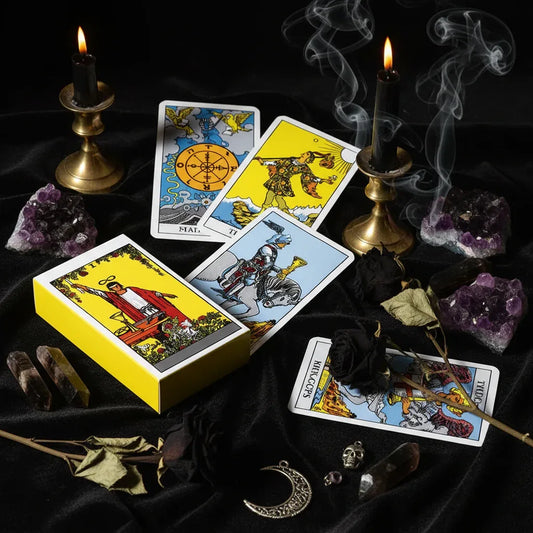
Occult societies such as the Hermetic Order of the Golden Dawn, founded in 1888, built elaborate rituals around elemental tools: the wand for fire, the cup for water, the dagger for air and the pentacle for earth. In 1909 the Rider Waite Smith tarot deck was published, illustrated by Pamela Colman Smith, and it remains the most widely used tarot design today.
When Wicca emerged in 1950s England, it adopted these elemental tools for the witch's altar, and they remain the core Wiccan set today.
Modern Witchcraft Supplies
| Tool | Roots | Modern use |
|---|---|---|
| Coloured candles | Sacred fire and lamps | Colour magic and spell activation |
| Crystals | Ancient amulets | Energy work, grids, healing, protection |
| Athame and wand | Ceremonial magic | Directing energy and casting circles |
| Chalice and pentacle | Golden Dawn elemental tools | Wiccan altar and offerings |
| Tarot | Fifteenth century Italian card games | Divination and reflection |
| Spell jars | Early modern witch bottles | Portable, lasting spells |
| Grimoire | Medieval magical manuscripts | A personal Book of Shadows |
What has not changed
Supplies evolve, but the heart of magic stays the same: intention, energy and connection to the unseen. A tool chosen with intention becomes a bridge between you and the energies you call on.
Witchcraft Tools Questions Answered
Where do the four Wiccan elemental tools come from?
The wand, chalice, athame and pentacle as a set of elemental tools come largely from nineteenth century ceremonial magic, especially the Golden Dawn, and were adopted into Wicca in the twentieth century.
Why is the cauldron linked with witches?
The cauldron was an everyday cooking pot, and much healing and folk magic happened over the hearth fire. Over time it became a symbol of transformation, rebirth and the witch herself.
When did crystals become popular in witchcraft?
Crystals have been used as amulets since ancient times, but their wide use in modern witchcraft grew with the New Age movement from the 1970s and 1980s onwards.
Tools for Today's Witch
Crystals, candles, tarot and altar tools rooted in tradition. Australian owned, shipping worldwide.