How to Learn Tarot in 30 Days: One Card a Day for Southern Hemisphere Witches
Share
How to Learn Tarot in 30 Days: One Card a Day for Southern Hemisphere Witches
A structured, low-pressure method for learning tarot from scratch using a single daily card, with a southern hemisphere seasonal lens built in.
Most beginner tarot guides assume you will memorise all 78 cards before you do anything useful with them. That approach works for some people and defeats most others. This guide takes a different route: one card per day for 30 days, structured so that the cards you meet each week build on each other, and so that the season you are actually in informs what you see.
Why One Card a Day Works
The tarot deck has 78 cards. If you try to learn them all at once, you end up with shallow knowledge of many things and deep knowledge of nothing. The one-card-a-day method solves this by forcing focus. You cannot move on until tomorrow. You have to actually sit with the card in front of you, notice what you notice, and let it appear in your day before you make a final judgment about what it means.
By the end of 30 days you have not memorised the whole deck, but you have built a real, embodied relationship with 30 cards. That is more useful than a surface-level scan of 78. The remaining cards wait. They are not going anywhere.
The second reason this method works is that it removes the anxiety of "getting it right." When you draw one card, you have one task: pay attention to this. Not 78 tasks. Not the pressure of a spread with positions and relationships and reversals. Just one card and one day.
What You Need Before You Start
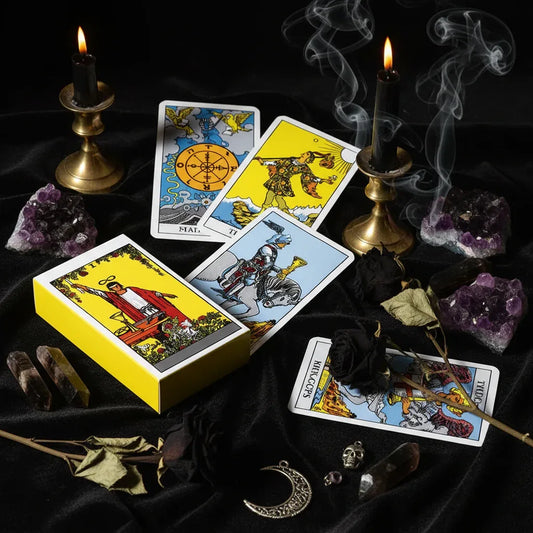
- A deck you can actually see. The Rider-Waite-Smith (RWS) tradition is recommended for beginners because most tarot resources and study guides are written around its imagery. Any deck that uses the RWS system works. Clear imagery matters more than beautiful illustration at this stage.
- A journal. You will write in it daily. A notebook dedicated to tarot keeps everything in one place and becomes a personal reference document over time.
- Five to ten minutes in the morning. That is genuinely all this requires. Draw the card, look at it, write three sentences. The rest happens as you move through the day.
You do not need a guidebook to begin, though having one as a reference is useful. Start with your own response to the imagery. What you see before you read what someone else says about it is often the most accurate reading you will ever give.
The 30-Day Structure
Rather than moving through the deck in numerical order (which puts 22 Major Arcana cards at the start and can be overwhelming), this structure alternates between the Major and Minor Arcana and groups Minor Arcana cards by suit so you build understanding of each suit's energy before moving to the next.
Major Arcana: The Journey Begins
The Fool (0), The Magician (I), The High Priestess (II), The Empress (III), The Emperor (IV), The Hierophant (V), The Lovers (VI). These seven cards introduce the foundational archetypes: the beginning, the will, the intuition, the abundance, the structure, the tradition, the choice.
Wands: Fire Energy
Ace, Two, Three, Four, Five, Six and Seven of Wands. The suit of fire covers passion, ambition, creative drive and conflict. In the southern hemisphere, Wands energy maps naturally onto the approaching summer months of November through February.
Cups: Water Energy
Ace, Two, Three, Four, Five, Six and Seven of Cups. The suit of water covers emotion, relationships, intuition and dreams. Cups connect well to autumn energy in the southern hemisphere, the season of harvest, reflection and turning inward.
Major Arcana: The Middle Path
The Chariot (VII), Strength (VIII), The Hermit (IX), Wheel of Fortune (X), Justice (XI), The Hanged Man (XII), Death (XIII). These cards introduce the deeper lessons: mastery, inner strength, solitude, fate, consequence, surrender and transformation.
Free Draw
On Days 29 and 30, draw without structure. Ask a real question. Let the deck respond. These two days are your first genuine readings, informed by everything you have learned in the four weeks before them.
Your Daily Practice
The Five-Minute Morning Ritual
Do this before you check your phone. The uncluttered morning mind gives better readings than the distracted afternoon one.
- Shuffle the deck briefly, or simply draw the next card in the sequence above.
- Place the card face up and look at it for 60 seconds without naming what you see. Notice colour, movement, feeling, the direction figures are facing.
- Write three sentences in your journal: what you see, what it makes you feel, and one guess about what this card might have to say about your day.
- Set the card somewhere visible. Your desk, beside your kettle, on the bathroom shelf. Let it be present in your day rather than returned immediately to the deck.
- That evening, write one final sentence: how the card's energy appeared (or conspicuously failed to appear) in what actually happened.
The Southern Hemisphere Seasonal Lens
Northern hemisphere tarot resources often use seasonal correspondences that run backwards for Australian witches. The Winter Solstice falls in June in Brisbane, not December. The harvest season is autumn, which arrives in March and April, not September. This matters when you are trying to understand the felt sense of a card's energy.
Some adjustments that make the southern hemisphere practice more intuitive:
- Wands (Fire). In the northern hemisphere these cards are associated with summer. In Australia, Wands energy peaks during the actual Australian summer: November through February. If you are working through the Wands week in October or November, the season is cooperating.
- Cups (Water). Associated with autumn, which in the southern hemisphere runs March through May. The energy of turning inward, releasing, and processing emotion tracks well with the actual autumn light and shortening days.
- Pentacles (Earth). Associated with winter in the north. In Australia, the winter months of June through August carry the same quality: slow, internal, concerned with resources, shelter and endurance.
- Swords (Air). Associated with spring's arriving energy. In the southern hemisphere, September through November carries the wind, disruption and mental clarity energy that makes Swords feel alive.
None of this means you cannot work with any suit at any time of year. It means that if you notice a card's energy feeling especially resonant or especially distant, the season may be part of why.
What to Do When You Draw a Card You Do Not Understand
This will happen, especially in the first two weeks. The right response is not to immediately open a guidebook. The right response is to sit with not knowing for a little longer. Write about what you do not understand. Describe the image in your journal as if you were writing to someone who cannot see it. What you have to articulate in order to describe it often surfaces the meaning you were looking for.
If the card genuinely resists you after the full day, then consult a reference. Note in your journal what the reference said and whether it matched your felt sense of the card. Disagreements are interesting. They are not failures. The tarot tradition is not monolithic, and your intuitive response to imagery is a legitimate form of knowledge.
Building Beyond 30 Days
After your 30 days, you have a journal full of personal observations, a felt sense of 30 cards, and the beginning of a real reading practice. Where you go next depends on what called you to tarot in the first place.
- If you want to deepen your understanding of the Minor Arcana suits, work through the remaining cards of each suit: Eights, Nines, Tens and Court Cards.
- If you want to understand the Court Cards (Page, Knight, Queen, King of each suit), spend a week with just the sixteen court cards. They are often the most confusing part of the deck and benefit from dedicated attention.
- If you want to begin reading spreads, start with three-card pulls (past, present, future, or situation, action, outcome) before moving to larger structures.
- If you want to work through the full Minor Arcana systematically, the Tarot Minor Arcana Workbook covers Wands and Cups with structured exercises, and Part 2 covers Swords and Pentacles.
Ready to Go Deeper with the Minor Arcana?
The Tarot Minor Arcana Workbook gives you structured exercises for every Wands and Cups card. Part 2 covers Swords and Pentacles. Work through both at your own pace.
Frequently Asked Questions
Do I need to memorise card meanings before I start?
No. The one-card-a-day method is specifically designed to build meaning through lived experience rather than memorisation. You will learn what the Five of Wands means partly from what the guidebook says and partly from what happened on the day you drew it. That second source of knowledge is more durable than memory alone.
Memorisation has its place later in a tarot practice, particularly for speed reading and for understanding the structural relationships between cards. At the beginning, it is a less efficient use of your time than actually engaging with one card at a time.
What if I draw the same card twice?
If you are drawing sequentially from the structure above, this will not happen. If you are drawing freely, drawing the same card more than once is worth noting in your journal. Recurring cards are usually trying to establish something the first appearances did not quite land. Write about why you think this card keeps finding you. The answer is usually more interesting than the card's traditional meaning.
Can I use reversed cards from the start?
You can, but it is not recommended in the first month. Reversals add a layer of interpretation that doubles the number of possible meanings for each card. Learning upright meanings first builds a foundation you can then complicate with reversals later. Many experienced readers choose not to use reversals at all and find their practice no less rich for it. It is a stylistic choice, not a requirement.
How long does it actually take to learn tarot?
That question has a frustrating answer: it depends what you mean by "learn." You can be giving yourself useful readings within a few weeks. You can be reading for other people competently within six months to a year of regular practice. You can study tarot seriously for twenty years and still find new things in the cards.
The 30-day method gives you a foundation. What you build on that foundation is determined by how often you practice and what you use the cards for. Daily use accelerates everything. Occasional use means slower growth but still real growth. There is no wrong pace.